Table of Contents
The short answer
Most of what keeps a mattress clean is work you can do yourself. Vacuum it when you change the sheets, deal with a spill or an accident within minutes, keep a washable protector on it and turn it head to foot every few months. What you cannot do at home is reach the dust that has worked down into the quilting, or shift sweat staining that has had years to set. That takes professional equipment and a stain treatment that goes on with very little moisture.
Two rules sit behind everything in this guide. Use as little liquid as you can, because a mattress is a thick sponge that cannot be wrung out or hung on a line. And let it dry all the way through before the sheets go back on. For blood and urine there is a third rule: cool water only. Heat fixes both into the fabric.
IHR Dream Cleaning cleans mattresses at your home. Our mattress cleaning service is priced by size: AED 79 for a single, AED 99 for a double or queen and AED 119 for a king, VAT included, with a minimum order of AED 100 per visit. For most beds once or twice a year is enough. The rest of this guide covers what to do between those visits and how to judge when one is due.
What builds up in a mattress
A mattress gets dirty slowly and from the top down. Nothing is spilled on it most nights, yet after a few years it is yellower and smells faintly stale. Three things do that, and a fourth looks like dirt but is not.
Sweat and body oil
A sleeping body gives off moisture and skin oil all night. Most of it goes into the sheet and the protector, and some passes through. The water evaporates. The salts and oils stay in the top layer of fabric and padding, and over months they darken as they react with the air. That is the pale yellow patch in the shape of a torso where each person sleeps.
Oil is the stubborn half. Fresh sweat is mostly water and salts and lifts easily. Body oil clings to the fibres, holds dust and turns yellow-brown with age, and by then no household product removes it without soaking the mattress. Sweat staining is something you slow down with a protector, not something you scrub out later.
Skin flakes, dust and sand
People shed skin constantly, and a bed collects more of it than any other piece of furniture. It works through the weave of the sheet with fibres from the bedding and ordinary house dust, and settles in the quilting, along the piping and in the button tufts. In Abu Dhabi there is fine sand in the mix as well. It comes in on clothes and through window and balcony seals, and it is gritty enough to wear the fabric where it sits.
Skin flakes are also what dust mites live on. Mites are too small to see, they do not bite, and they are common in household beds everywhere. If you are trying to work out what is behind itching or a blocked nose in the morning, the guide to dust mites or bed bugs sets the two apart and says who deals with each.
Damp that never quite leaves
In a home where the AC runs most of the year the air is dry, and a mattress gives up the night's moisture during the day. The trouble comes when that stops: a bed made tight the moment you get up, a mattress on a solid base or on the floor, a spare room with the AC off through a humid summer, or a flat closed for weeks while the family travels. A mattress that stays slightly damp starts to smell musty, and one left that way grows mould in the padding.
Yellowing that is not dirt
The cover and the foam under it also discolour with age as they react with air and light. That yellowing is even, has no edge and no smell, and no cleaning removes it. Staining from sweat has a shape and is deepest where the body lies. Telling the two apart saves the mattress from being over-wetted in pursuit of a colour change that is not available.
The routine you can do yourself
This takes about fifteen minutes and fits into the day you change the bed. Once a month is a sound rhythm for a bed in nightly use. A guest bed can wait until just before and just after a guest.
- Strip the bed completely, protector included, and put the linen straight into the wash.
- Leave the mattress bare for an hour with the AC running, so the night's moisture can leave.
- Fit the upholstery nozzle to the vacuum and check that it is clean. A floor head that has been across the kitchen puts grease and grit onto the fabric.
- Vacuum the top in slow, overlapping passes, along the length and then across. Slow matters more than pressure: the suction needs time to pull dust up through the quilting.
- Go round the piping, the seams, the handles, the label and any button tufts with the edge of the nozzle. This is where dust collects and where a quick pass misses.
- Vacuum the four sides, then stand the mattress up and do the underside, the base or slats and the floor under the bed.
- Wipe the frame and headboard with a barely damp cloth, and remake the bed with a clean protector.
Air the bed every morning
The cheapest habit is the simplest one. Fold the duvet back to the foot of the bed when you get up and leave it there while you shower and dress. The night's moisture leaves a bare sheet far faster than it leaves a made bed.
Bicarbonate of soda: what it does and what it does not
Sprinkling bicarbonate of soda over a bare mattress, leaving it for a few hours and vacuuming it off is the home treatment most people have heard of. It is safe for the fabric, and it takes the edge off a light stale smell because the powder absorbs some odour and a little moisture. It does not clean anything. It will not lift a stain, and it does nothing about dust below the surface. Use a thin layer, vacuum it out slowly and check the vacuum's filter afterwards, because fine powder clogs filters quickly.
What to keep away from a mattress
Some common cleaning tools and products do a mattress more harm than good.
- A carpet washer or wet vacuum. It puts in far more water than the mattress can give back.
- A household steam cleaner. It drives heat and moisture into the padding, and heat sets blood and urine marks for good.
- Bleach. It weakens and yellows the fabric, and it must never meet another cleaning product or a urine stain, because the fumes are harmful.
- Scented sprays used in place of cleaning. They cover a smell for a day and leave moisture and residue behind.
- An iron or a hair dryer on its hottest setting to hurry the drying. Heat sets stains and is hard on foam.
Treating marks: sweat, urine and blood
The same handling applies to every mark on a mattress, whatever caused it. Get these habits right and the exact product matters much less.
- Act while it is wet. A mark treated in the first few minutes usually goes. One found a week later usually only fades.
- Blot, do not rub. Press a folded dry towel onto the spot and lean on it. Rubbing pushes the liquid deeper and roughs up the fabric.
- Use cool water, on the cloth and not on the mattress. The cloth should be damp, never dripping.
- Use white cloths or plain kitchen paper, and work from the outside of the mark towards the middle so you do not spread a ring.
- Use one product at a time. Never mix cleaners, and rinse one out before trying another.
Sweat marks and stale patches
A fresh damp patch from a hot night needs air more than it needs cleaning. Strip the bed and leave it bare. If a mark remains once it is dry, mix a few drops of washing-up liquid into a bowl of cool water, wring a white cloth out in it until it is only damp, and dab the area. Follow with a second cloth damp with plain water, then press with a dry towel. Soap left in the fabric goes sticky and attracts dust, so the rinse is not optional.
Old yellow staining is a different matter. At home the honest result is a little lighter, not gone, and repeating the treatment only adds water. A professional stain treatment lightens these marks considerably, and even then old, set-in stains may not disappear completely.
Urine
Speed decides the outcome with urine more than with anything else. Fresh, it is nearly all water and comes out with pressure and patience. Left to dry, it leaves salts and a smell that returns whenever the air is humid. Our technicians treat urine with an enzyme-based product for the same reason you should: it breaks the odour down where a perfume only covers it.
For a child who is still having accidents, a waterproof protector is worth more than any cleaning method. Pets are a subject of their own, covered in the guide to pet hair, odour and accidents on sofas and carpets.
- Strip the bed at once and put the linen in the wash.
- Press thick dry towels onto the wet area and put your weight on them. Change towels and repeat until they come away almost dry. Most of the job is done at this stage, before any cleaner is involved.
- Dab the area with a cloth wrung out in cool water, then press dry again. This dilutes what is left.
- Apply an enzyme-based cleaner made for urine, following its label for the amount and for how long to leave it.
- Blot once more, then leave the mattress bare with the AC on and a fan across it until it is completely dry.
- Smell the spot when it is dry. A trace that comes back on a humid day means some is left below the surface, and a second treatment or a professional clean is the next step.
Blood
Blood is a protein stain, and protein behaves like egg white: warmth cooks it into the fibre. Cold water keeps it soluble. That one fact is most of what there is to know.
Stain removers that work by releasing oxygen will lift more, but they can also lighten the fabric around the mark, so test on the side of the mattress first or leave it to a professional. A small old mark under a protector is better left than soaked.
- Blot a fresh mark with dry kitchen paper. Lay a cold damp cloth on a dried one for a few minutes to soften it.
- Wring a white cloth out in cold water and dab from the outside in. Turn to a clean part of the cloth each time it colours.
- Keep going until the cloth stays clean. This takes longer than people expect. Do not switch to warm water to hurry it.
- If a shadow remains, dab with cold water and a drop of washing-up liquid, then rinse with a cloth damp with plain water.
- Press dry with a towel and leave the mattress bare until it is fully dry.
Why a mattress has to dry all the way through
A sheet dries in an hour because air reaches both sides of something a millimetre thick. A mattress is twenty or thirty centimetres of padding, foam and springs with air reaching one face. Liquid that gets past the top layer sits where nothing moves, and it leaves slowly.
What stays damp turns musty. Warmth, moisture and the skin flakes already inside a mattress are what mould needs, and once mould is growing in the padding it cannot be cleaned out from the surface. Damp also undoes the cleaning: wet fibres hold the dust that lands on them, and humid bedding is the condition dust mites do well in. Making the bed over a damp mattress seals all of that in.
How to dry a mattress properly
Drying is a matter of dry air and movement. Heat is not needed.
- Leave it completely bare: no sheet, no protector, no duvet folded on top.
- Keep the AC running in the room. Air-conditioned air is dry air, and it is the most useful drying tool in the home.
- Point a fan across the surface, not straight down at it. Moving air carries the moisture away.
- If the wet went deep, stand the mattress on its long side against a wall so both faces are open to the air.
- In the humid summer months keep the balcony door and windows shut. Outside air then puts moisture in instead of taking it out.
How to tell it is dry
Touch alone is unreliable, because the surface dries first. Press a dry paper towel hard onto the treated area for ten seconds and look at it. Then lay the back of your hand on the spot: a patch that feels cooler than the fabric around it is still giving off moisture. After a spot treatment allow several hours. After anything that reached the padding, leave it overnight and sleep somewhere else.
Memory foam and other all-foam mattresses
Foam mattresses need the most care with liquid. Memory foam is dense, takes in water readily and gives it up slowly, and a soaked foam core can take days to dry. Keep any treatment to a damp cloth on the cover. If the cover zips off, read its label: many can be machine-washed, which is the easy answer to most stains.
Protectors, rotating and the base under the bed
Cleaning a mattress is slow and never complete. Keeping it from getting dirty is quick and nearly complete.
Choosing and washing a protector
A protector is a fitted, washable layer between the sheet and the mattress. It takes the sweat, the oil and the spills, and it goes in the washing machine, which the mattress cannot. A quilted cotton or polyester pad absorbs moisture, but a large spill goes through it. A waterproof protector has a thin membrane under a fabric face that stops liquid while letting some vapour pass. For a child's bed, a guest bed and any bed where drinks are carried, the waterproof kind is the one to buy.
Choose one that covers the sides as well as the top, and wash it as its label says, since high heat damages many waterproof membranes. In normal use wash it every month or two, and straight after any spill. Owning two means the bed is never left bare waiting for the wash. Read the mattress warranty as well: some makers exclude a stained mattress.
Rotating and flipping
Turn the mattress head to foot every few months. It spreads the wear and the sweat staining over both ends and slows the hollow that forms where the heavier sleeper lies. Flipping it over is a different matter. Many modern mattresses are built one-sided, with the comfort layers on top only, and a pillow-top can never be flipped. The maker's label or leaflet is the thing to trust.
Air under the mattress
A mattress needs air from below. A slatted base gives it. A solid platform, a storage divan packed tight or the bare floor does not, and moisture collects on the underside where you never look. If the bed has a solid base, stand the mattress up for an hour when you change the sheets.
How often a mattress should be professionally cleaned
Our published guidance is every 6 to 12 months, and more often in a home where someone is sensitive to dust. Monthly vacuuming and a protector hold the surface. The professional visit is for what they cannot reach: dust below the top layer and staining that has started to set.
Sofas, carpets and curtains run on different clocks, and the schedule for all four is in how often to clean sofas, carpets, mattresses and curtains. For the mattress alone, where you fall between six months and twelve depends on the bed.
- Used every night with no protector, a young child's bed, or a bed a pet sleeps on: every six months, and after any accident that reached the mattress.
- Used every night, always under a protector that is washed regularly: once a year.
- A guest bed used a few weeks a year: before guests are due, not by the calendar.
Times when it is worth doing whatever the date
Some events justify a clean however recent the last one was.
- You move into a furnished flat and inherit mattresses someone else slept on.
- A baby is on the way, or a cot mattress is being passed down.
- Someone has been ill in bed for days.
- A tenant or a guest has left and the next one is due.
- You come back to a home that was shut up over the summer and the bedrooms smell stale. The guide to reopening a home after summer travel covers the other rooms.
What a professional mattress clean involves
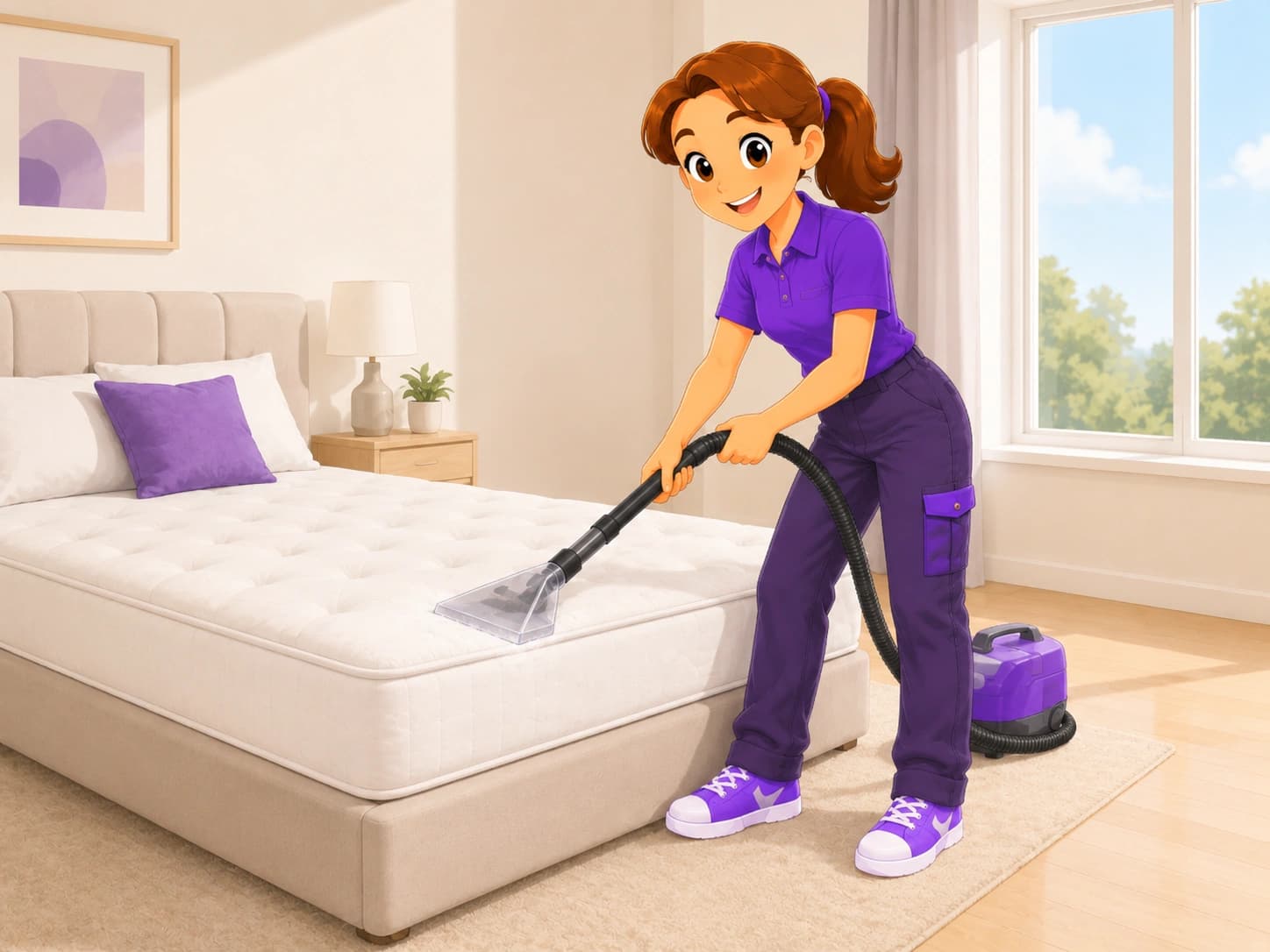
The visit is short and follows the same order each time. Allow about 30 to 45 minutes per mattress, plus the drying time afterwards.
- Inspection. The technician checks the fabric and the labels and points out any stains that may not fully lift. This happens before the work starts, not after.
- Deep vacuuming. Both accessible sides and the edges are vacuumed to lift dust, skin flakes and debris from the surface layers.
- Stain and odour treatment. Spots are treated with products that are safe for the fabric, and the whole surface is given a freshness treatment.
- Drying. The mattress is left to air-dry. Most are ready to use again the same day.
How different mattresses are handled
Say what kind of mattress it is when you book. The construction changes how much moisture it can take.
| Mattress | How it is cleaned |
|---|---|
| Spring and pocket-spring | On both accessible sides |
| Memory foam | With minimal moisture, so the foam does not hold water |
| Pillow-top and hybrid | Quilted top cleaned with care; deep stains may only lighten |
| Child's or cot mattress | Priced as a single; mild products, drying time given before the child uses it |
What to check before the technician leaves
Five minutes at the end saves a phone call later.
- Ask which stains were treated and what to expect from each once dry. Some marks look darker while they are damp.
- Ask how long this mattress needs before the bed is made. It depends on the mattress and on how much treatment the stains took.
- If you find afterwards that something was missed, tell us within 24 hours of the visit and we will come back and re-clean it without charge.
What mattress cleaning costs
The price is per mattress, not per hour, and it already includes 5% VAT. There is no call-out fee and no extra charge for a Friday, a weekend or a public holiday.
| Mattress size | Price |
|---|---|
| Single | AED 79 |
| Double or queen | AED 99 |
| King | AED 119 |
The minimum order and two worked examples
There is a minimum order of AED 100 per visit across all priced fabric items. A double and a single together come to AED 178, which clears it. Where one mattress on its own falls short, the difference can be made up with other items on the same visit, such as a rug, a few curtain panels or a sofa, which the sofa cleaning page prices at AED 30 a seat.
A family home with one king and two singles comes to AED 277. At 30 to 45 minutes each that is around two hours of work, so a morning booking has all three beds back in use that night.
Mattresses booked together with a deep clean or a move-in or move-out clean are 10% off. That suits the start of a tenancy in a furnished flat, when the rooms and the beds both need doing. What the rooms get is set out on the deep cleaning page.
The prices of all four fabric services are compared in sofa, carpet, mattress and curtain cleaning prices explained, and every figure is on the price list.
When a mattress is past cleaning
Cleaning deals with what is on the surface and just below it. It cannot repair what has gone wrong inside. These are the signs that the money is better spent on a replacement.
- Mould you can see, or a musty smell that comes back after the mattress has been cleaned and fully dried. Growth inside the padding cannot be reached.
- It has been soaked through: a leak from the AC or the ceiling, a flood, or a spill that reached the core and was not dried within a day or so.
- Urine has gone in deep many times over. The smell returns in humid weather however often the surface is treated.
- It sags, keeps a hollow when nobody is lying in it, has springs you can feel or hear, or has foam that no longer springs back. Cleaning changes none of these.
- The cover is torn or the filling is coming through.
What is not a reason to replace it
Stains on their own are not. A mattress with old sweat marks that is clean, dry, free of smell and still supportive has years left under a protector. Bed bugs are not an automatic reason either. Most mattresses can be treated, and throwing one out without treating the bed frame and the room solves nothing. The guide to bed bugs in Abu Dhabi explains why.
If you cannot tell which side of the line a mattress is on, send photos when you book and say what happened to it. The inspection before the work starts is the point at which you are told what a clean can and cannot do for it.
Common questions
How long before I can sleep on it?
Usually a few hours in an air-conditioned room. Book a morning slot if you need the bed that night, leave the mattress bare with the AC on, and make the bed only when it is dry right through. If a stain needed heavy treatment, go by what the technician tells you for that mattress and not by the general figure.
Does cleaning get rid of dust mites?
It reduces what they live on. Deep vacuuming takes dust and skin flakes out of the layers it can reach, and a washable protector fitted afterwards keeps the level down. It does not remove every mite or every trace of allergen, and nobody can honestly claim that it does. Nor is it a treatment for a skin or breathing condition: symptoms that persist are a matter for a doctor.
Does it get rid of bed bugs?
No. Cleaning removes dust. Bed bugs are insects that hide in seams, bed frames and headboards, and their eggs are stuck into cracks that a vacuum does not empty. If you have seen an insect, dark dots along the piping or pale shed skins, book pest control first, which is a separate service, and have the mattress cleaned once the treatment is finished.
My mattress smells musty but has no stains. Will cleaning fix it?
Often, yes. A musty smell usually comes from humidity, and a clean followed by a thorough dry and regular airing usually resolves it. Find the cause at the same time, or it will return: a solid base with no airflow, a room left without AC through the summer, or a bed made too soon each morning.
Can the mattresses be done on the same visit as my regular clean?
Yes, with notice. Fabric work uses different equipment from an hourly clean and is priced by the item, so tell us the number and sizes when you book and it can usually be scheduled alongside the clean. That saves a second appointment.
Is it worth cleaning the mattresses in a furnished flat I have just moved into?
It is one of the commonest reasons people book. You do not know how the previous occupant used the bed or whether a protector was ever on it. Check each bed for signs of bed bugs first, because that needs a different service and is far easier to deal with before your own belongings are unpacked. Then have the mattresses cleaned, fit your own protectors and start your own routine from a known point.
How to book, and what to have ready
Book online on the website or in the IHR Dream app. Choose mattress cleaning, the number of mattresses of each size and a time. Visits run every day, 8 AM – 8 PM, and a morning slot gives the mattress the afternoon to dry.
After you book, send photos of any stains by email and say what caused them if you know, which also lets the technician bring the right products. Photos are usually enough for us to confirm the method and the final price. Payment is online by card, from My bookings on this website once the price is confirmed.
You can cancel or move the booking free of charge up to 6 hours before it starts. What the service includes is on the mattress cleaning page. When you know how many mattresses there are, book a visit.
Before the technician arrives
Four small things make the visit quicker and the result better.
- Strip the bedding and the mattress protector.
- Clear space around the bed so both sides can be reached.
- Point out the stains and say what caused each one.
- Plan to keep the room air-conditioned or ventilated afterwards, and arrange another place for a child's nap if a cot mattress is being cleaned.