Table of Contents
The short answer
Three things are safe on almost any sofa: vacuuming it every week, blotting a fresh spill with a dry white cloth, and airing it. A fourth is safe on most fabric sofas once you have checked the care label and tested a hidden spot: lifting a fresh mark with a little water and a drop of mild soap, blotted and dried quickly.
Stop there with leather beyond a wipe, with velvet, silk, viscose and linen, with loose covers that might shrink, with any fabric coded S or X, with old stains, and with smells that come from inside the cushions. Those are the jobs where a home attempt most often turns a mark into damage: a water ring, a patch of crushed pile, colour that has bled, or detergent left in the foam that keeps drawing dirt.
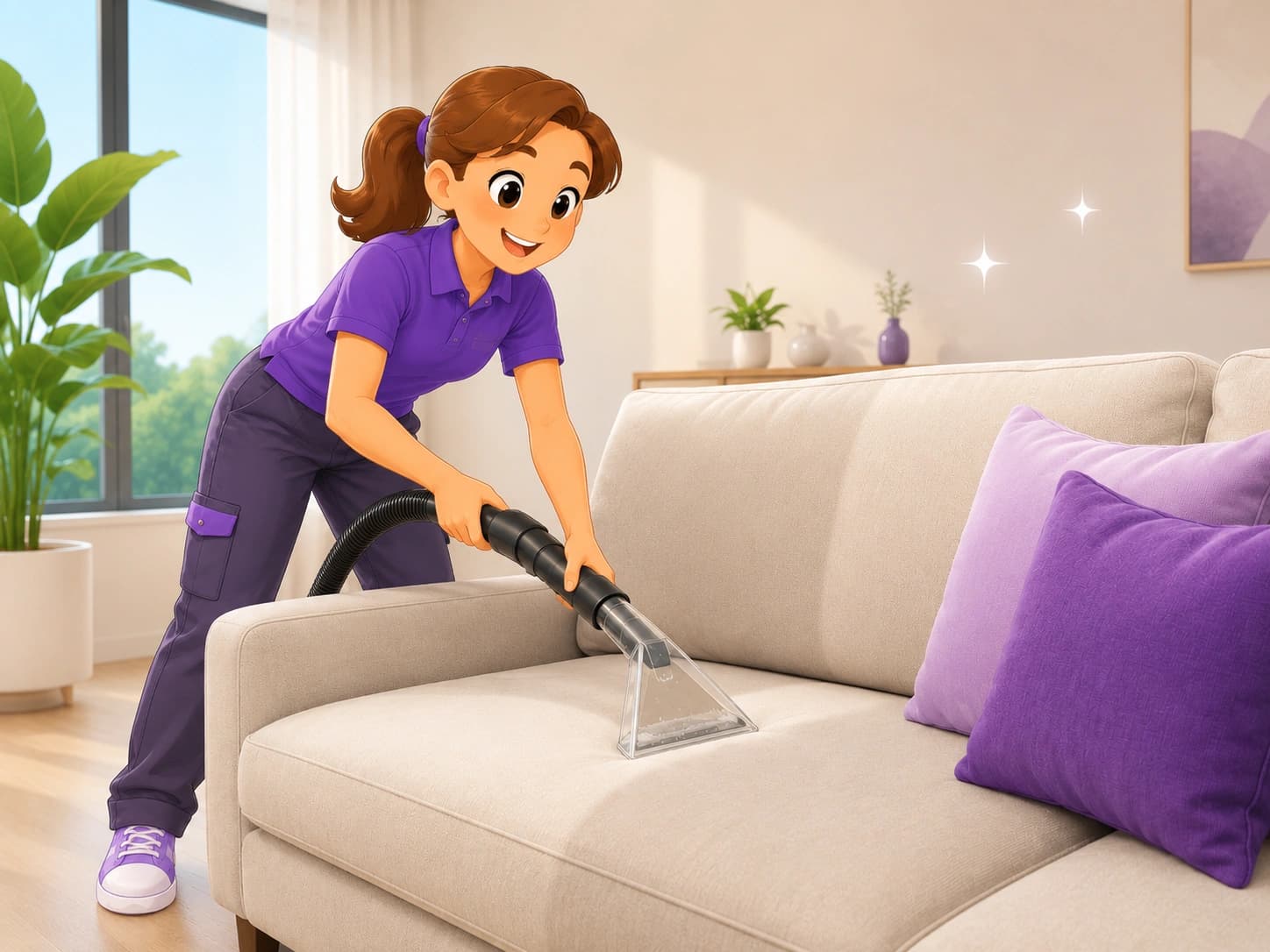
Most of this guide is about the first group, and how to do the safe things properly. The rest is about recognising the second group early. When a sofa needs more than you can safely give it, our sofa cleaning service works from photos of the fabric and the marks, and it helps a great deal if nothing has been rubbed into them first.
Find the care code before anything touches the fabric
Many sofas carry a cleaning code. Look on the platform under the seat cushions, on the underside of the frame, along a seam inside a zipped cushion cover, or on the tag that was attached when the sofa was delivered. It is one letter or a pair of letters.
| Code | Meaning | What that allows at home |
|---|---|---|
| W | Water-based cleaning | Water and a mild soap solution, tested first |
| S | Solvent only | Vacuuming and dry blotting; no water |
| WS or SW | Water-based or solvent | As for W, tested first |
| X | Vacuum only | Vacuuming and a soft brush; no liquid of any kind |
If there is no label
Treat the sofa as the most cautious case until a test tells you otherwise. Custom-made pieces often have no code, and older sofas have often lost theirs. Identify the fabric if you can: the receipt or the shop's listing usually names it. Velvet, silk, viscose, linen and anything with a sheen or a raised pile belongs in the stop group whatever a test says.
What the code does not tell you
The code is about the cover fabric only. It says nothing about the dye, the cushion filling or how the piece is put together. A W-coded cotton can still show a water ring if it is soaked and dried slowly, and a W-coded loose cover can still shrink in a washing machine. The code tells you what kind of cleaner is allowed. The patch test tells you what your own sofa does with it.
What to have ready, and what to leave in the cupboard
You need very little, and none of it is specialised.
- A vacuum cleaner with an upholstery nozzle and a soft brush attachment.
- White cotton or microfibre cloths. White matters, because coloured cloths and printed paper towels can pass their dye to a damp fabric.
- A spray bottle of clean water. Tap water here is hard and can leave a mineral mark as it dries, so use bottled or filtered water on pale fabrics.
- A mild, clear washing-up liquid with no colour and no added bleach. A few drops in a cup of water is the whole recipe.
- A spoon or a blunt knife for lifting solids.
- A fan.
Leave these in the cupboard
Each of these is the cause of damage that cannot be cleaned away afterwards.
- Bleach and anything that contains it. On most upholstery it removes colour, and lost colour cannot be cleaned back.
- Glass cleaner, kitchen degreaser and multi-purpose sprays. They are made for hard surfaces and are too strong for dyed fabric.
- Coloured soaps and laundry detergents with brighteners, which can leave a mark of their own.
- A hair dryer on hot, an iron or a steam cleaner. The section on what sets a stain explains why.
- Any two products together. Never mix cleaning products and never put one over another. Bleach with an acid or with ammonia gives off dangerous fumes.
The weekly routine: dry work first
Most of what makes a sofa look tired is dry: dust, sand, crumbs, hair and skin flakes. It comes out with a vacuum, and it has to come out before any liquid goes near the fabric, because water turns dust into mud and mud into a stain. In Abu Dhabi the dry part matters more than in most places. Fine sand works its way into the seams and under the cushions and wears at the fibres from there.
- Take off every loose cushion and throw. Shake the throws out on the balcony or outside.
- Vacuum the platform under the cushions, pushing the nozzle into the crevice where the seat meets the back and the arms. This is where sand and crumbs collect.
- Vacuum each cushion on every side, seams included.
- Vacuum the back, the arms and the front panel in overlapping strokes. On velvet and other pile fabrics use the soft brush and follow the direction of the pile.
- Wipe wooden or metal legs and trim with a barely damp cloth, keeping it off the fabric.
- Put the cushions back in different positions, turned over if they are reversible, so that wear and fading are shared.
- Once a month, pull the sofa forward and vacuum under and behind it.
Hair and stale smells
Pet hair that the vacuum leaves behind lifts with a slightly damp rubber glove drawn across the fabric in one direction. Hair, odour and accidents together have a guide of their own: pets at home: hair, odour and accidents on sofas and carpets.
A sofa that smells stale but looks clean usually needs air before it needs a product. Stand the cushions on edge, run the AC and a fan for a few hours, and vacuum again. On a dry, W-coded fabric a light sprinkle of bicarbonate of soda, left for an hour and vacuumed out thoroughly, takes the edge off a surface smell. Use little. Powder left in the weave turns pasty the next time the fabric gets damp.
How to patch test
Every liquid, plain water included, is tested on your sofa before it goes anywhere you can see. It is ten minutes of work and a few hours of waiting. Do it on a quiet day, and you will already know the answer when a spill happens.
- Choose a hidden place made of the same fabric: the back of the skirt, the underside of a seat cushion, the inside of a zip flap.
- Dampen a white cloth with the liquid you intend to use. Do not pour it on.
- Press the cloth on the spot for half a minute, then look at the cloth. Any colour on it means the dye is not fast. Stop there.
- Blot the spot with a dry cloth and let it dry completely, with a fan if you like. This takes a few hours.
- Check it in daylight. A ring, a darker or paler patch, a change in texture or flattened pile all mean the same thing: this fabric is not for wet cleaning at home.
Reading the result
No colour on the cloth and no visible change once dry means that liquid is safe for small, light use on that fabric. It does not mean the sofa can be soaked. The test also covers only what you tested. Water passing does not clear soap, and soap passing does not clear anything stronger.
A fresh spill: the first five minutes
Speed matters more than product. A spill blotted within a minute has mostly not reached the filling. The same spill an hour later has soaked in, spread and begun to dry at the edges, which is where rings form.
- Lift any solids with a spoon, working from the outside towards the middle.
- Blot with a dry white cloth. Press straight down, hold, lift, and move to a clean part of the cloth. Do not rub. Rubbing spreads the spill, roughens the fibres and pushes the liquid deeper.
- Keep blotting until the cloth comes up almost dry. Most of the job is done at this point.
- If the code is S or X, stop here and leave the rest to a professional.
- If the code is W or WS and your patch test passed, dampen a clean cloth with cool water and blot again, from the edge of the mark inwards.
- If a mark remains, put a few drops of mild soap in a cup of water, whisk it, and take only the foam on the cloth. Dab. Do not scrub.
- Rinse by blotting with a cloth dampened in clean water, two or three times, until no soapiness is left.
- Press a dry towel on the area to take out as much moisture as you can, then dry it quickly with a fan and the AC.
The first move for common spills
The steps above cover most spills. A few need a different first move, and a few should not be treated at home at all.
| Spill | First move | Do not |
|---|---|---|
| Tea, coffee, juice, soft drinks | Blot, then cool water | Leave it for later: sugar browns as it ages |
| Milk, egg, blood | Blot, then cold water only | Use warm or hot water, which sets it |
| Oil, butter, greasy food | Blot, cover with bicarbonate of soda or cornflour, vacuum after 15 minutes | Add water first, which spreads the oil |
| Mud | Let it dry, then vacuum | Wipe it while it is wet |
| Wax or chewing gum | Harden with ice in a bag, then lift the pieces | Use heat, or pull at the fibres |
| Ink, marker, nail varnish | Blot once and stop | Wet it or rub it |
| Pet urine or vomit | Lift, blot firmly, then follow the pets guide | Use steam or a perfumed spray |
What sets a stain: the mistakes that cost the most
A stain is set when it has bonded to the fibre or changed it, so that cleaning no longer shifts it. Home treatment sets more stains than time does. These are the usual ways.
- Rubbing. It breaks the surface of the fibres, so the area looks different even after the spill has gone, and it drives liquid into the filling.
- Heat. Hot water, a hair dryer, an iron or steam fixes protein stains such as milk, egg and blood into the fibre, and fixes many dyes and sugars too.
- Too much water. A soaked patch dries from the edge inwards and leaves a ring where the dissolved dirt stops. The filling under it can stay damp for days and begin to smell.
- Too much soap. What is not rinsed out dries sticky. The spot looks clean for a week, then turns grey as it collects dust.
- One product after another. A second spray on top of the first can fix the stain or strip the colour around it, and it limits what a professional can do afterwards.
- Waiting. A spill that dries clear, such as lemonade, can turn brown weeks later, when it is far harder to remove.
The clean patch problem
There is one more trap, and it is not a mistake in method. On a sofa that has not been cleaned for a year, a spot you clean well will be cleaner than the fabric around it. The result is a pale patch that looks like a stain in reverse. Nothing fixes that except cleaning the whole panel evenly, which is a job for a machine. If your test spot dries visibly lighter than its surroundings, the sofa is due for a full clean, and spot-cleaning will only draw a map of where the spills were.
Where to stop
The cases below have one thing in common. The damage from getting them wrong is permanent, and the fabric gives no warning before it happens.
Leather
Finished leather, the kind with a slight sheen that does not darken under a damp fingertip, can be dusted and wiped with a soft cloth wrung almost dry, then dried at once. That is the whole of home care. Soap, baby wipes, kitchen oils and multi-purpose sprays can strip or clog the finish and leave the leather dry and liable to crack. Suede, nubuck and unfinished leather absorb everything, water included, and should only be brushed.
Conditioning is worth doing, with a product made for that type of leather and tested on a hidden spot first. Our own practice follows the same principle: leather is cleaned and conditioned with leather products, and never shampooed.
Velvet, chenille and other pile fabrics
Pile is thousands of upright fibre ends. Water makes them lie down and dry flat, and rubbing bends them for good, so the patch catches the light differently from the rest of the sofa even when it is perfectly clean. Vacuum with a soft brush in the direction of the pile, blot spills with no more pressure than the weight of your hand, and stop.
Silk, viscose and linen
Silk and viscose water-mark from plain water. Viscose is also weak when wet, and its surface distorts. Linen and loosely woven cotton shrink and wrinkle as they dry, and can brown if they dry slowly. If your sofa has a soft sheen or a slubby natural weave, find out what the fabric is before you test anything on it.
Loose covers
A zip does not mean a cover is washable. Zips are fitted so that the cushion can be filled. If the label does not say the cover can be washed, do not wash it. If it does, follow it exactly: wash every cover of the set together so the colour stays even, use cool water, and put the covers back on while they are still very slightly damp, so that they ease into shape as they finish drying. A cover that has shrunk even a little will not close, and nothing stretches it back.
Old stains and smells from inside the cushion
An old stain has already been through whatever the household tried on it, and each attempt narrows what can be done next. Leave it alone, and tell the technician what caused it and what has been used.
A smell that returns every time the room warms up is in the filling, not in the cover. That covers pet urine, spilled milk and a cushion that was once soaked. Cleaning the surface removes the mark and leaves the source, and adding water carries it through more of the foam.
Washing the whole sofa
Cleaning a full sofa means putting detergent into every panel and getting it out again, evenly, while the filling stays dry. Without a machine that extracts, the detergent stays in and the water goes down. A home carpet washer used on upholstery puts in far more water than a cushion can give back. This is the line between spot care and a clean, and it is the usual point at which to book one.
Drying: the step people skip
A small damp patch should be dry within an hour or two. Help it along.
- Run the AC and point a fan across the patch, not straight down at it.
- Stand a damp cushion on its edge so that air reaches both faces. Do not put it back in the sofa until it is dry right through.
- Keep it out of direct sun, which fades fabric.
- Keep the windows shut on humid or dusty days. Humid air slows drying, and damp fabric collects dust.
- Do not sit on it, and keep pets off it.
If a ring appears
A ring is dirt and minerals carried to the edge of the wet area and left there. On a W-coded fabric that passed its test, you can try once to soften the edge. Dampen a white cloth with bottled water, wring it nearly dry, and feather the ring outwards with light dabs so that no hard line remains. Then dry it fast with a fan. If the ring is still there the next day, stop. A second and a third attempt make it wider.
When to call, and what to tell us
The decision is usually simple.
| Situation | What to do |
|---|---|
| Weekly dust, crumbs and hair | Yourself: vacuum |
| Fresh spill on a W or WS fabric | Yourself: blot, water, a little soap, dry |
| Fresh spill on S, X, velvet, silk, viscose or linen | Blot dry only, then call |
| A stain more than a few days old | Call |
| A smell from inside the cushions | Call |
| General greying, dull arms and headrests | Call: the whole sofa needs cleaning |
| A ring or patch left by a home attempt | Call, and say what was used |
What a professional visit adds
A technician brings what a household does not have: a machine that puts solution in and takes it out again, products matched to the stain and the fabric, and the experience to judge which marks will lift. Our process starts with your photos. On arrival the fabric and its colour-fastness are checked in a hidden spot. Then come thorough dry vacuuming, spot treatment of each mark, and a low-moisture shampoo or extraction where the fabric allows it. Before leaving, the technician tells you how long the sofa needs to dry.
General greying is the clearest case. It is usually embedded dust and not a stain, and a full shampoo or extraction pass typically brings back noticeably more colour than wiping does. Which method suits which fabric is explained in shampoo, steam or dry cleaning, and what is realistic for old stains is covered in our earlier article on what to know before booking sofa and carpet cleaning.
What to send when you book
Send a photo of the whole sofa with the number of seats, a photo of the care label, and a close-up of each mark. Say what caused each one if you know. Then list every product that has been used on it, however mild. That last point matters most, because it changes what can safely be tried next.
Sofa cleaning is AED 30 per seat, with a minimum order of AED 100 per visit, and the method and the final price are confirmed from the photos before the visit. How seats are counted is in the fabric care price list explained.
Common questions about cleaning a sofa yourself
Can I use a steam cleaner on my sofa?
It is rarely a good idea. Steam adds heat and moisture and takes nothing away, so the loosened dirt stays in the fabric unless it is wiped or extracted. The heat can set stains, flatten pile and mark delicate fabrics. On a sturdy W-coded synthetic it may freshen the surface. On anything else it is a risk with little to gain.
Which sofa cleaning liquid should I buy?
For a W or WS fabric, a mild, clear, dye-free washing-up liquid diluted in water is all a fresh spot needs. Purpose-made upholstery cleaners exist for water-safe fabrics and for solvent-only ones. Choose by the care code and not by the promise on the front of the bottle, follow the instructions on the back, and test it first. Be wary of anything that claims to work on every fabric and every stain. No single liquid does.
Are bicarbonate of soda and vinegar safe?
Bicarbonate of soda used dry, in small amounts, on a dry W-coded fabric and vacuumed out thoroughly is low in risk, and it helps with surface smells and fresh grease. Vinegar is an acid. On some dyes and natural fibres it leaves a mark, so it needs the same patch test as any other liquid. Mixing the two makes a fizz that looks active and cleans very little, because each cancels the other out.
I tried to clean a mark and made it worse. What now?
Stop adding things. Blot the area dry, let it dry fully and photograph it. Write down every product that went on, in order. A ring or a stiff patch left by soap can sometimes be evened out by a full clean of the panel. Colour that has been bleached out and pile that has been scrubbed flat cannot be restored, and it is better to hear that from photos before a visit than after one.
What is the easiest way to keep a new sofa clean?
Keep the care label and the name of the fabric from the receipt. Put a washable throw on the seat that gets used most, keep meals off the sofa where you can, vacuum weekly and turn the cushions monthly. Do the patch test in the first week, before the first spill. A sofa cared for like that reaches its first professional clean with nothing set in it.
How often does a sofa need a professional clean?
Every six to twelve months for most households, and sooner where there are children, pets or frequent guests. Weekly vacuuming is what lets a sofa reach the long end of that range. The reasoning, for sofas and for the other fabrics in the home, is in how often sofas, carpets, mattresses and curtains should be cleaned.
Do the same rules apply to carpets and rugs?
The principles do: dry soil out first, test, blot, use little water and dry fast. The details differ, because a carpet has a backing and a floor beneath it and no care code. They are set out in keeping a carpet clean between professional washes.
Do the safe things well, and hand over the rest
Vacuum weekly. Know your code. Test before you need to. Blot fast, use little and dry quickly. That handles most of what a sofa meets in a year, and it keeps the fabric in a state where a professional clean can still do its full work.
For everything in the stop group, the sofa cleaning page sets out what a visit includes and how to prepare for it. Book online, send the photos, and the method and the price are confirmed to you before the visit.